OCC – obstructing vegetation on Pulhams bus route
OCC are requesting landowners remove obstructing vegetation on the Pulhams bus route as a double decker bus will be used from September.
Published: 12 August 2025

Letter being sent to landowners from OCC – Countryside and Volunteer Co-ordination, Environment and Place
Dear Landowner
Obstructing vegetation:
I am writing following a recent enquiry from Pulham Coaches about changes to a bus route through your village to ask for your assistance. Pulhams will be using a double decker bus on the existing school bus route through Spelsbury. To ensure the safety of children from your community travelling to the Cotswold School please read this letter and take any action that is required.
Being a landowner you have both a common and statutory duty of care to ensure that trees/vegetation on your land does not overhang a highway or any other road or footpath to which the public has access so as to endanger or obstruct the passage of vehicles or pedestrians, or obstructs or interferes with the view of drivers of vehicles or the light from a public lamp.
Statutory Clearance over the highway is 5.2m and 2.5m over footways. Trees & vegetation must also be cut back sufficiently from the edge of the carriageway to allow clearance for wing mirrors.
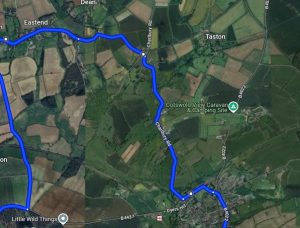
We would be extremely grateful if you could familiarise yourself with the route shown on these maps. If you own land along the route please ensure that any trees or hedges that you own are pruned adequately to allow a double decker bus to pass safely.
There is a clear safety concern with overhanging trees endangering bus users. A broken windscreen on a bus is expensive to repair. More importantly a school child could be injured by broken glass. If this were to happen the owner of the tree may be liable for costs relating to personal injury and damage to property.
Work on trees that are protected by Conservation Area or Tree Protection Order should always be notified to the Planning Authority here Protected trees – West Oxfordshire District Council
Any active birds nest is protected and works that may disturb an active nest should be delayed until the nesting season is finished.
The County Council does have statutory powers to enforce this Highway Clearance and will act if this is required. We would very much appreciate your cooperation to resolve the potential risk informally.
highwayenquiries@Oxfordshire.gov.uk
Advisory Notes for Land Owners
- Duty of Care: In general we recommend that all trees situated adjacent to and within falling distance of the public highway are inspected by a suitably qualified arboriculturalist to ensure they are as safe as reasonably practicable to the public highway or its users. This should be done on a regular basis to maintain your trees within acceptable levels of safety. Owners of trees have a legal duty of care to take reasonable steps to avoid any foreseeable risk to persons likely to be affected by any omissions of that duty of care i.e. failure to take any action in respect of a potentially dangerous tree may result in claim of negligence in common law.
- Highways Act 1980: Section 154 part (2): Where it appears to a competent highway authority of any road or footpath to which the public has access,- (a) that any hedge, tree or shrub is dead, diseased, damaged or insecurely rooted, and (b) that by reason of its condition it, or part of it, is likely to cause danger by falling on the highway, road or footpath, the authority may, by notice either to the owner of the hedge, tree or shrub or to the occupier of the land on which it is situated, require him within 14 days from the date of service of the notice so to cut or fell it as to remove the likelihood of danger.
- The term dead, dying or dangerous used in the letter covers a vast array of defects that can be found in trees. Further hazards may be identified following a more detailed inspection by a competent arboriculturist.
- It is recommend that all trees situated adjacent to and within falling distance of the public highway are inspected by a suitably qualified arboriculturist to ensure they do not pose a danger to the public highway or its users. This should be done on a regular basis to maintain your trees in a safe manner.
- Not all trees will require complete removal and many trees can simply be reduced in size or pruned to create natural habitats.
- Prior to undertaking tree works you must contact your Local Planning Authority (District Council) to see if your trees are afforded any statutory protection in the form of a Tree Preservation Order (or if you live within a Conservation Area). We are happy to discuss works that are required as some of them may fall within the dead, dying or dangerous category and as such are exempt from statutory protection (it is however up the land owner to check this prior to works commencing).
- Trees provide valuable habitats for wildlife especially older mature trees with cavities and holes. Birds & bats nest/roost in them and it is essential that you check for their presence prior to any works being undertaken as they are protected by law under The Wildlife & Countryside Act 1981 and Conservation of Habitats & Species Regulations 2010. Please see the following links for further information.
http://jncc.defra.gov.uk/page-1376 or www.naturalengland.org.uk
- All tree works should be undertaken by competent professionals who hold appropriate training/certification and the relevant insurances (as tree works tend to be of a dangerous nature).
- A list of Arboricultural Association (AA) approved contractors operating in your area can be obtained from the AA via their website www.trees.org.uk or by telephone on 01794 368 717.
- Any arboricultural contractors working on the Public Highway must hold the relevant traffic management training and £10 million public liability insurance (as this is a County Council policy).
- If you require further information please feel free to contact the Tree Team on 0845 310 1111 or view our website www.oxfordshire.gov.uk